



-
 ৳650.00
 -
৳319.00
৳350.00 -
৳1,650.00
৳2,300.00

Reviews & Ratings
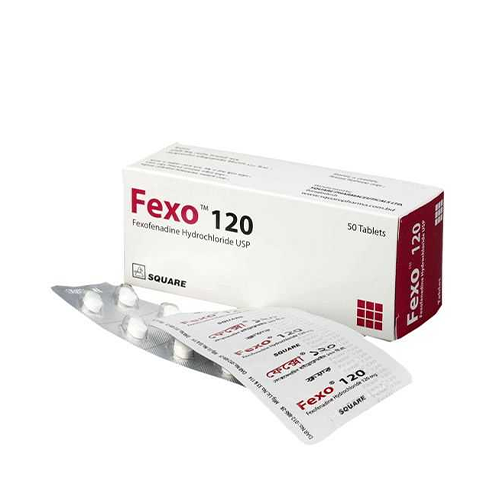
Fexo 120 Mg~ 1 Strip
- Tablet- Fexofenadine Hydrochloride
- Manufacturer: Square Pharmaceuticals PLC.
Indications of Fexo 120 mg
Allergic rhinitis: In adults and children 12 years of age and
older, Fexo 120 mg is recommended for the alleviation of seasonal and persistent
allergic rhinitis symptoms. Sneezing, rhinorrhea, lacrimation, itchy, red eyes,
and itchy nose, palate, and throat are symptoms that can be properly addressed.
Both work/activity productivity and health-related quality of life are enhanced
with fexofenadine. For the treatment of the symptoms of chronic idiopathic
urticaria in adults and children 12 years of age and older, fexofenadine is
recommended. The number of wheals and pruritus associated with chronic
idiopathic urticaria are dramatically decreased by fexofenadine. Both
work/activity productivity and health-related quality of life are enhanced with
fexofenadine.
Theropeutic Class
Non-sedating antihistamines
Pharmacology
A selective peripheral H1-receptor antagonist, Fexo 120 mg is an
antihistamine. After oral administration, it is quickly absorbed and reaches
peak plasma concentration in 2 to 3 hours. The blood-brain barrier does not
appear to be crossed by it.
Dosage & Administration of Fexo 120 mg
Seasonal Allergic Rhinitis-Adults and children 12 years and
older: Tablet: 60 mg twice daily or 120 mg once daily or 180 mg once daily
In case of impaired renal function: 60 mg once daily Children
from 6 to 11 years: Tablet: 30 mg twice daily or 60 mg once daily
In case of impaired renal function: 30 mg once daily Children
from 2 to 11 years Suspension: 30 mg or 5 ml twice daily
In case of impaired renal function: 30 mg or 5 ml once daily
Chronic Idiopathic Urticaria-Adults and children 12 years and
older: Tablet: 60 mg twice daily or 120 mg once daily or 180 mg once
daily In case of impaired renal function: 60 mg once daily Children from
6 to 11 years: Tablet: 30 mg twice daily or 60 mg once daily
In case of impaired renal function: 30 mg once daily Children
from 6 months to less than 2 years: Suspension: 15 mg or 2.5 ml (1/2 tsp) twice
daily
In case of impaired renal function: 15 mg or 2.5 ml (1/2 tsp)
once daily Children from 2 to 11 years: Suspension: 30 mg or 5 ml (1 tsp) twice
daily
In case of impaired renal function: 30 mg or 5 ml (1 tsp) once
daily
Dosage of Fexo 120 mg
Allergic Rhinitis-Adults and children 12 years and older:
Tablet: 60 mg twice daily or 120 mg once daily or 180 mg once daily In case of
impaired renal function: 60 mg once daily Children from 6 to 11 years: Tablet:
30 mg twice daily or 60 mg once daily In case of impaired renal function: 30 mg
once daily Children from 2 to 11 years Suspension: 30 mg or 5 ml twice
daily In case of impaired renal function: 30 mg or 5 ml once daily Chronic
Idiopathic Urticaria-Adults and children 12 years and older: Tablet: 60 mg
twice daily or 120 mg once daily or 180 mg once daily In case of impaired
renal function: 60 mg once daily Children from 6 to 11 years: Tablet: 30 mg
twice daily or 60 mg once daily In case of impaired renal function: 30 mg once
daily Children from 6 months to less than 2 years: Suspension: 15 mg or 2.5 ml
(1/2 tsp) twice daily In case of impaired renal function: 15 mg or 2.5 ml (1/2
tsp) once daily Children from 2 to 11 years: Suspension: 30 mg or 5 ml (1 tsp)
twice daily In case of impaired renal function: 30 mg or 5 ml (1 tsp) once
daily
Interaction of Fexo 120 mg
As fexofenadine does not go through hepatic biotransformation,
hepatic processes cannot be used to interact with other medications. It has
been discovered that co-administration of Fexo 120 mg with erythromycin or
ketoconazole causes a 2- to 3-fold increase in fexofenadine levels in plasma.
When compared to the medication given separately, the adjustments had no influence
on the QT interval and were not followed by an increase in unfavorable
reactions. There was no evidence of a connection between fexofenadine and
omeprazole. However, there was a decrease in bioavailability when Fexo 120 mg
was administered 15 minutes before an antacid comprising gels of aluminum and
magnesium hydroxide, most likely as a result of binding in the gastrointestinal
tract. It is advised to wait two hours between the time Fexo 120 mg is
administered and aluminum and magnesium hydroxide-containing antacids.
Contraindications
Those with known hypersensitivity to Fexo 120 mg or any of its
components should not use it.
Side Effects of Fexo 120 mg
When appropriate, the following frequency rating has been
applied: Extremely common: 1/100; Common: 1/100; Uncommon: 1/1,000; Rare:
1/10,000; Very rare: 1/10,000; and Not known: 1/1,000 (frequency cannot be
estimated from the available data). Unwanted effects are listed within each
frequency grouping in descending order of seriousness. Clinical trials have
revealed the following negative effects in adults, with a prevalence comparable
to that seen with a placebo: Common nervous system illnesses include headaches,
fatigue, and vertigo. Frequent gastrointestinal issues include nausea, along
with general issues and issues with the administration site. - Unusual:
exhaustion. The following negative consequences have been observed in
post-marketing surveillance in adults. They do not occur frequently and their
frequency cannot be calculated from the data currently available. Immune system
problems, including hypersensitive reactions that include angioedema, tightness
in the chest, dyspnea, flushing, and systemic anaphylaxis; Mental illnesses
such as anxiety, nightmares, sleeplessness, or excessive dreaming (paroniria);
cardiac issues such as palpitations and tachycardia; Diarrhea as a
gastrointestinal condition; Disorders of the skin and subcutaneous tissues:
rash, urticaria, and pruritus.
Pregnancy & Lactation
Fexo 120 mg is under category C by the US FDA for pregnancy.
Therefore, it is advised to avoid using Fexo 120 mg during pregnancy and
lactation unless the advantages to one outweigh the hazards to the fetus.
Precautions & Warnings
There is little information on elderly persons and patients with
renal or hepatic impairment, as is the case with the majority of new
medications. In these particular categories, Fexo 120 mg administration needs
to be done carefully. Antihistamines as a class of medication have been linked
to adverse responses such as tachycardia and palpitations, so patients with a
history of active cardiovascular disease should be informed of this. Impacts on
the capacity to operate machinery and drive: Fexofenadine hydrochloride tablets
are unlikely to have an impact on one's ability to drive or operate machinery
based on the pharmacodynamic profile and recorded adverse events. Fexofenadine
has not been found to significantly affect the central nervous system's ability
to function in objective testing. This entails that patients can operate a
vehicle or complete other demanding jobs. Therefore, it is advisable to examine
the individual response before driving or undertaking difficult duties in order
to recognize sensitive individuals who have an unusual reaction to the
medication.
Overdose Effects of Fexo 120 mg
Overdoses of Fexo 120 mg have been associated with symptoms such
as dry mouth, sleepiness, weariness, and dizziness. Healthy participants have
received single doses of up to 800 mg, doses of up to 690 mg twice daily for
one month, or doses of up to 240 mg once daily for one year without
experiencing clinically significant adverse responses in comparison to placebo.
Fexofenadine hydrochloride has no known upper limit of tolerable dosage. To get
rid of any unabsorbed medication, standard procedures should be taken into
account. Treatment for symptoms and psychological assistance is advised.
Fexofenadine hydrochloride cannot be efficiently removed from the blood by
hemodialysate.
Storage Conditions
Keep dry and away from heat and light. Keep out of children's
reach.
Drug Classes
Non-sedating antihistamines
Mode Of Action
The H1 histamine receptor is responsible for mediating
hypersensitivity and allergic reactions. Hypersensitivity and allergic
responses are mediated by the H1 histamine receptor. Mast cells and basophils
degranulate in response to allergen exposure, releasing histamine and other
inflammatory mediators as a result. Histamine binds to and activates H1
receptors, which causes basophils and mast cells to further release
pro-inflammatory cytokines such as interleukins. Many allergy symptoms,
including pruritus, rhinorrhea, and watery eyes, are caused by these histamine
binding's downstream effects. Because it binds to and stabilizes the inactive
version of the receptor, fexofenadine is referred to as an "inverse
agonist" of the H1 receptor because it prevents the receptor's activation
and consequent downstream effects. There is no proof that it has
antidopaminergic, antiserotonergic, anticholinergic, sedative, or adrenergic
blocking effects, despite having a strong and specific affinity for H1
receptors. As fexofenadine cannot cross the blood-brain barrier, it is unlikely
to have a substantial impact on the central nervous system.
Pregnancy
The use of Fexo 120 mg in pregnant women is not supported by
enough data. There aren't any direct or indirect negative effects on pregnancy,
embryonal/fetal development, parturition, or postnatal development, according
to the few available animal studies. If not absolutely required, Fexo 120 mg
shouldn't be taken while pregnant. Data about the composition of human milk
following the administration of Fexo 120 mg are lacking. Fexofenadine was
discovered to pass into human breast milk when Terfenadine was given to nursing
mothers. Fexofenadine hydrochloride is therefore not advised for moms who are
nursing their infants. Fexofenadine hydrochloride's effect on fertility has not
been studied in humans. The medication with Fexo 120 mg had no impact on
fertility in mice.
Pediatric Uses
Patient with renal and hepatic impairment: People with renal
impairment have different fexofenadine pharmacokinetics. In patients with
impaired renal function, a dose of 60 mg once daily is advised as the initial
dose due to increases in bioavailability and half-life. The pharmacokinetics of
fexofenadine are not significantly impacted by moderate to severe hepatic
disease. The patient over 65: Adverse effects in this group were comparable to
those in patients under 65. Yet in people over 65, fexofenadine's pharmacokinetics
are changed (its bioavailability is enhanced).
Q: What is Fexo 120mg?
Fexo 120mg is an antihistamine used to relieve hay fever and hives by blocking
the effects of histamine, a chemical released during allergic reactions.
Q: Do I need to take doctor suggestions before starting to take
Fexo 120mg?
Consulting your doctor before taking any medication, including Fexo 120mg, is a
good idea. Your doctor will evaluate your specific situation to ensure that
Fexo 120mg is the appropriate choice for you.
Q: Can I take the Fexo 120mg Tablet during pregnancy?
It's best to steer clear of Fexo 120mg when pregnant, as it could harm your
baby. Consult your doctor for a similar, safer alternative medication.
Q: Who should avoid taking Fexo 120mg?
Anyone with the following issues should should avoid Fexo 120mg -
allergic to fexofenadine or similar ingredients, liver or kidney issues, heart
problems, pregnant or breastfeeding and children under age of 12.
Q: Is Fexo 120mg Tablet an antibiotic?
Fexo 120mg Tablet is not an antibiotic. It is an antihistamine, which means it
helps to relieve the symptoms of allergies.
Q: What are the side effects of Fexo 120mg?
The most common side effects of Fexo 120mg are drowsiness, headache, and dry
mouth. Other side effects that may occur include dizziness, fatigue, nausea,
and vomiting.
Disclaimer
The information provided is accurate to our best practices, but
it does not replace professional medical advice. We cannot guarantee its
completeness or accuracy. The absence of specific information about a drug
should not be seen as an endorsement. We are not responsible for any
consequences resulting from this information, so consult a healthcare
professional for any concerns or questions.
Frequently Brought Products
Product Queries (0)
Login Or Registerto submit your questions to seller
Other Questions
No none asked to seller yet
-
৳650.00
-
৳319.00
৳350.00 -
৳1,650.00
৳2,300.00

Subscribe to our newsletter for regular updates about Offers, Coupons & more
Follow Us
Mobile Apps