



-
 ৳650.00
 -
৳319.00
৳350.00 -
৳1,650.00
৳2,300.00

Reviews & Ratings
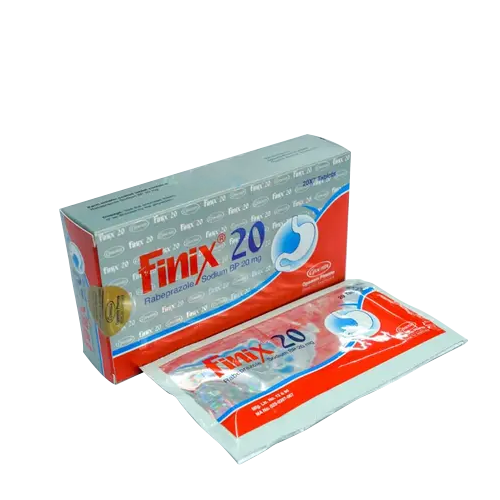
Finix 20 mg~ 1 Strip
- Tablet Rabeprazole Sodium
- Manufacturer: Opsonin Pharma Ltd.
Indications of Finix 20 mg
Gastro-resistant
tablets of rabeprazole are recommended for the treatment of: Active ulcer in
the duodenum. benign stomach ulcer that is active. Symptomatic gastroesophageal
reflux illness that is erosive or ulcerative (GERD). Disorder of the
Gastro-esophageal Reflux Long-Term Planning (GERD Maintenance) Moderate to
extremely severe gastroesophageal reflux disease symptoms (symptomatic GERD)
Syndrome of Zollinger-Ellison. Helicobacter pylori removal in patients with
peptic ulcer disease in conjunction with suitable antibacterial therapy
regimens.
Theropeutic Class
Proton
Pump Inhibitor
Pharmacology
The
gastric H+/K+-ATPase at the secretory surface of the stomach parietal cell is
inhibited by rabeprazole, which reduces gastric acid secretion. It has been
said that Rabeprazole acts as an inhibitor of the gastric proton pump since
this enzyme is thought to be the acid (proton) pump within the parietal cell.
Dosage & Administration of Finix 20 mg
Duodenal
ulcer: Rabeprazole 20 mg in the morning for 4 weeks. Most patients heal within
4 weeks.Healing of erosive or ulcerative Gastroesophageal Reflux Disease (GERD):
Rablet 20 mg daily in the morning for 4 to 8 weeks. Those patients who have not
healed after 8 weeks of treatment, an additional 8-week course of Rabeprazole
may be considered.Treatment of symptomatic GERD: The recommended adult oral
dose of Rabeprazole is 20 mg once daily in the morning for 4 weeks. If symptoms
do not resolve completely after 4 weeks, an additional course of treatment may
be considered.Maintenance of healing of erosive or ulcerative GERD: The
recommended adult oral dose of Rabeprazole is 20 mg once daily. Controlled
studies do not extend beyond 12 months.Zollinger-Ellison Syndrome: The
recommended adult oral starting dose is 60 mg once a day. Doses should be
adjusted according to individual patient needs and should continue for as long
as clinically indicated. Some patients may require divided doses. Doses up to
100 mg once daily and 60 mg twice daily have been administered.Helicobacter
pylori eradication to reduce the risk of Duodenal Ulcer recurrence: Rabeprazole
20 mg, Amoxicillin 1000 mg, Clarithromycin 500 mg twice daily in the morning
and evening with meals for 7 days
Dosage of Finix 20 mg
Active
Duodenal Ulcer and Active Benign Gastric Ulcer: The recommended oral dose for
both bioactive duodenal ulcer and active benign gastric ulcer is 20 mg to be
taken once daily in the morning. Most patients with active duodenal ulcer heal
within four weeks. However, a few patients may require an additional four weeks
of therapy to achieve healing. Most patients with active benign gastric ulcer
heal within six weeks. However, again a few patients may require an additional
six weeks of therapy to achieve healing.Erosive or Ulcerative Gastro-Esophageal
Reflux Disease (GERD): The recommended oral dose for this condition is 20 mg to
be taken once daily for four to eight weeks.Gastro-Esophageal Reflux Disease
Long-term Management (GERD Maintenance): For long-term management, a
maintenance dose of Finix 20 mg or 10 mg once daily can be used depending upon
patient response.Symptomatic treatment of moderate to very severe
Gastro-Esophageal Reflux Disease (symptomatic GERD): 10 mg once daily in
patients without oesophagitis. If symptom control has not been achieved during
four weeks, the patient should be further investigated. Once symptoms have
resolved, subsequent symptom control can be achieved using an on-demand regimen
taking 10 mg once daily when needed.Treatment of GERD in pediatric patients 1
to 11 years of age (Less than 15 kg): 5 mg once daily for 12 weeks with the
option to increase to 10 mg if inadequate response.Treatment of GERD in
pediatric patients 1 to 11 years of age (15 kg or more): 10 mg once daily for
12 weeks. Zollinger-Ellison Syndrome: The recommended adult starting dose
is 60 mg once a day. The dose may be titrated upwards to 120 mg/day based on
individual patient needs. Single daily doses up to 100 mg/day may be given. 120
mg dose may require divided doses, 60 mg twice daily. Treatment should continue
for as long as clinically indicated.Eradication of H. pylori: Patients with H.
pylori infection should be treated with eradication therapy. The following
combination given for 7 days is recommended. Rabeprazole sodium 20 mg twice
daily, clarithromycin 500 mg twice daily and amoxicillin 1g twice daily.
Administration of Finix 20 mg
Although
neither the time of day nor food intake was demonstrated to have any effect on
Finix 20 mg activity, taking these pills in the morning before eating will make
it easier for patients to adhere to the treatment plan. Patients should be
informed that the pills of rabeprazole should not be chewed or mashed but
rather consumed whole.
Interaction of Finix 20 mg
Significant
and persistent inhibition of stomach acid output is brought about by respite. A
compound whose absorption is pH-dependent may interact with another substance.
Itraconazole or ketoconazole co-administration with Finix 20 mg may cause a
considerable drop in antifungal plasma levels. Consequently, when ketoconazole
or itraconazole are used concurrently with Respite, individual patients may need
to be watched to determine if a dosage adjustment is warranted. There was no
apparent interaction with liquid antacids. Atazanavir is pH-dependently
absorbed. As a result, PPIs, such as rabeprazole, shouldn't be taken alongside
atazanavir.
Contraindications
Hypersensitivity
to any excipient or active ingredient. The use of Finix 20 mg during pregnancy
and breastfeeding is not advised.
Side Effects of Finix 20 mg
In
both short- and long-term studies, Finix 20 mg is generally well tolerated. In
some cases, rabeprazole may result in headache, nausea, vomiting, constipation,
dry mouth, increased or decreased appetite, muscle pain, sleepiness, and
dizziness.
Pregnancy & Lactation
FDA
pregnancy category "C" in the US. There is no proof that Rabeprazole
affects fertility or causes harm to the fetus, according to studies done on
animals. Nevertheless, there isn't any good, controlled research on pregnant
women. Since that rabeprazole is probably excreted in human milk, a choice
should be made regarding whether to stop breastfeeding or to stop the
medication, taking into account the significance of the medication to the
mother.
Precautions & Warnings
Before
starting treatment with Finix 20 mg Gastro-resistant Tablets, the risk of
malignancy should be ruled out because the presence of stomach or oesophageal
malignancy is not precluded by the symptomatic response to therapy with
rabeprazole. Long-term patients should be regularly monitored, especially those
who have been on medication for more than a year. Proton pump inhibitors,
particularly when used in high dosages and for extended periods of time (>1
year), may slightly increase the risk of hip, wrist, and spine fracture, mostly
in elderly patients or when other known risk factors are present. Proton pump
inhibitors may raise the total risk of fracture by 10% to 40%, according to
observational studies. Other risk factors could account for some of this
increase. Individuals who are at risk for osteoporosis should be looked after
and should consume enough calcium and vitamin D.
Overdose Effects of Finix 20 mg
The
highest exposure that has been determined has never gone above 60 mg twice
daily or 160 mg once daily. Effects are often mild, typical of recognized
adverse event profiles, and reversible without additional medical help. There
is no known particular antidote. Due to its high protein binding, rabeprazole
cannot be dialyzed. Treatment for overdose should be symptomatic, as with any
overdose, and broad supportive techniques should be used.
Storage Conditions
Keep
away from light and moisture at a temperature below 30°C. Keep out of
children's reach.
Use In Special Populations
It is
unknown whether rabeprazole is safe and effective for use in children.
Drug Classes
Proton
Pump Inhibitor
Mode Of Action
The
gastric H+/K+-ATPase at the secretory surface of the stomach parietal cell is
inhibited by rabeprazole, which reduces gastric acid secretion. It has been
said that Rabeprazole acts as an inhibitor of the gastric proton pump since
this enzyme is thought to be the acid (proton) pump within the parietal cell.
Pregnancy
FDA
pregnancy category "C" in the US. There is no proof that Rabeprazole
affects fertility or causes harm to the fetus, according to studies done on
animals. Nevertheless, there isn't any good, controlled research on pregnant
women. Since that rabeprazole is probably excreted in human milk, a choice
should be made regarding whether to stop breastfeeding or to stop the
medication, taking into account the significance of the medication to the mother.
Pediatric Uses
Hepatic
and renal impairment: Patients who have these conditions don't require dosage
adjustments. Rabeprazole is not advised for usage in pediatric populations
since there are insufficient data on its safety and effectiveness.
Q:
What is Finix 20mg?
Finix 20mg is a proton pump inhibitor (PPI) medication that is used to treat
gastroesophageal reflux disease (GERD), a condition in which stomach acid backs
up into the esophagus, causing heartburn, acid regurgitation, and other
symptoms. Finix 20mg works by blocking the production of stomach acid.
Q:
What are the side effects of Finix 20mg?
The most common side effects of Finix 20mg are diarrhea, constipation, nausea,
and vomiting. Other side effects include headache, dizziness, rash, and dry
mouth. Serious side effects are rare but can include kidney problems, liver
damage, and bone fractures.
Q:
How should I take Finix 20mg?
Finix 20mg should be taken with food. The usual dose is one tablet once a day.
Do not take more than the prescribed dose.
Q:
Can I take Finix 20mg while pregnant or breastfeeding?
Finix 20mg is not recommended for use during pregnancy or breastfeeding. If you
are pregnant or breastfeeding, talk to your doctor about the risks and benefits
of taking Finix 20mg.
Q:
What should I do if I overdose on Finix 20mg?
If you overdose on Finix 20mg, call your doctor or the Poison Control Center
immediately. Overdose can cause symptoms such as drowsiness, confusion, and
seizures.
Q:
How long should I take Finix 20mg?
The length of time you need to take Finix 20mg will depend on the condition you
are being treated for. For GERD, the usual treatment course is 4-8 weeks. For
other conditions, your doctor will determine the length of treatment.
Q: Is
there anything else I should know about Finix 20mg?
Finix 20mg can cause dry mouth. To relieve dry mouth, drink plenty of fluids
and suck on sugarless candy or ice chips. Finix 20mg can also cause
constipation. To prevent constipation, eat a high-fiber diet and drink plenty
of fluids.
Disclaimer
The
information provided is accurate to our best practices, but it does not replace
professional medical advice. We cannot guarantee its completeness or accuracy.
The absence of specific information about a drug should not be seen as an
endorsement. We are not responsible for any consequences resulting from this
information, so consult a healthcare professional for any concerns or
questions.
Frequently Brought Products
Product Queries (0)
Login Or Registerto submit your questions to seller
Other Questions
No none asked to seller yet
-
৳650.00
-
৳319.00
৳350.00 -
৳1,650.00
৳2,300.00

Subscribe to our newsletter for regular updates about Offers, Coupons & more
Follow Us
Mobile Apps