



-
 ৳650.00
 -
৳319.00
৳350.00 -
৳660.00
৳900.00


Reviews & Ratings
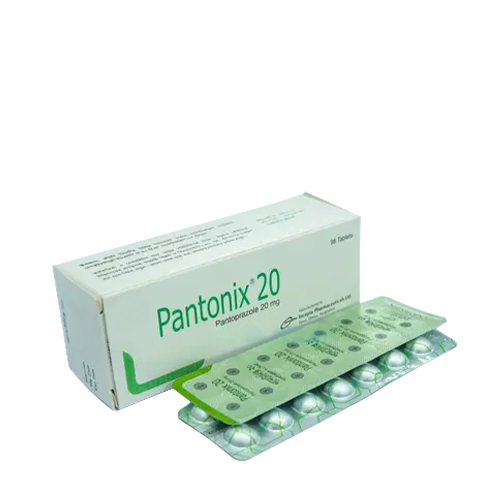
Pantonix 20 Mg~ 1 Strip
- Tablet-Pantoprazole
- Manufacturer: Incepta Pharmaceuticals Ltd.
Indications of Pantonix 20 mg
Pantonix 20 mg is recommended when
inhibiting acid secretion is therapeutically beneficial, i.e. Stomach ulcer
disorders. Illnesses caused by gastroesophageal reflux. Non-steroidal
anti-inflammatory drug-induced ulcer (NSAIDs) Helicobacter pylori eradication
(in combination with antibiotics) Syndrome of Zollinger-Ellison
Theropeutic Class
Proton Pump Blocker.
Pharmacology
Pantonix 20 mg is a proton pump
inhibitor that works by covalently attaching to the H+/K+ATPase enzyme system
on the surface of the gastric parietal cell to decrease the last stage of
gastric acid generation. Regardless of the stimulus that remains for more than
24 hours, this impact results in a suppression of both basal and induced
stomach acid secretion.
Dosage & Administration of Pantonix 20 mg
Oral: Benign gastric ulcer: 40 mg
daily in the morning for 4 weeks, continued for further 4 weeks, if not fully
healed. Gastro-esophageal reflux disease: 20-40 mg daily in the morning for 4
weeks, continued for further 4 weeks, if not fully healed; maintenance dose is
20 mg daily, which may be increased to 40 mg daily. Duodenal ulcer: 40 mg daily
in the morning for 2 weeks, continued for further 2 weeks if not fully healed.
Duodenal ulcer associated with Helicobacter pylori: Pantonix 20 mg is
recommended at a dose of 40 mg twice daily in association with antimicrobial
agents as detailed below: Amoxycillin 1 g and Clarithromycin 500 mg both twice
daily for one week, or Clarithromycin 250 mg and Metronidazole 400 mg both
twice daily for one week. Prophylaxis of NSAID-associated gastric or duodenal
ulcer: 20 mg daily for those require long-term NSAID treatment.
Zollinger-Ellison Syndrome: Initially 80 mg once daily adjusted according to
response (elderly max. 40 mg daily); daily doses above 80 mg given in 2 divided
doses. IV Injection: Duodenal ulcer and gastric ulcer: 40 mg once daily
for 7-10 days Gastroesophageal reflux disease associated with a history of
erosive esophagitis: 40 mg once daily for 7-10 days Prevention of
rebleeding in peptic ulcer: IV 80 mg, followed by 8 mg/hour infusion for
72 hours Prophylaxis of acid aspiration: 80 mg IV every 12 h for 24 h, followed
by 40mg every 12 hour Long-term management of Zollinger-Ellison Syndrome and
other pathological hypersecretory conditions: 80 mg IV every 12 hours, may
increase to 80 mg every 8 hours if needed, may titrate to higher doses
depending on acid output.
Interaction of Pantonix 20 mg
In clinical investigations, no
significant medication interactions were found.
Contraindications
Those with known hypersensitivity to
any of the formulation's ingredients should not take Pantonix 20 mg.
Side Effects of Pantonix 20 mg
Both in the short-term and the
long-term, Pantonix 20 mg is well tolerated. The most frequent adverse effects
are headache and diarrhea, while abdominal pain, flatulence, rash,
sleeplessness, and hyperglycemia are only rarely reported side effects.
Pregnancy & Lactation
Pantonix 20 mg is classified as a B
pregnancy drug by the US FDA. Nevertheless, there isn't any good, controlled
research on pregnant women. This medication should only be used during
pregnancy if clearly necessary, as a human response to treatments is not
usually predicted by studies on animal reproduction. It has been demonstrated
that Pantonix 20 mg is excreted in human milk. So, a choice should be taken on
whether to stop nursing or stop taking the medication, taking into account the
benefit of the medication to the mother.
Precautions & Warnings
Patients should be advised not to
split, chew, or crush the Pantonix 20 mg pill. The use of Pantonix 20 mg for an
extended period of time may cause malabsorption of cyanocobalamin (Vitamin B12)
or raise the risk of problems linked to osteoporosis.
Overdose Effects of Pantonix 20 mg
There are no recognized signs of
human overdose. Due to its strong protein binding, Pantonix 20 mg is not easily
dialyzable. There is no specific therapy that is advised, other symptomatic and
supportive management.
Storage Conditions
Keep dry and away from heat and
light. Keep out of children's reach.
Reconstitution
Direction for use of IV injection:
Pantonix 20 mg lyophilized powder with 0.9% Sodium Chloride Injection must only
be administered intravenously and under no other circumstances. A gradual
intravenous dose of Pantonix 20 mg should be administered. The
powder-containing vial is mixed with 10 ml of 0.9% sodium chloride injection to
create the IV injection solution. Upon reconstitution, the injection should be
administered gradually over a minimum of 2 to 5 minutes. Use just recently made
solutions. The reconstituted solution can be kept for up to 4 hours at room
temperature (up to 30° C). How to administer an IV infusion: An intravenous
infusion of Pantonix 20 mg should be administered over roughly 15 minutes. An
IV infusion of Pantonix 20 mg needs to be reconstituted with 10 ml of 0.9%
sodium chloride injection before being further diluted (admixed) to a final
volume of 100 ml using 0.9% sodium chloride injection, 5% dextrose, or lactated
ringer's injection. Prior to further dilution, the reconstituted solution may
be kept at room temperature (up to 30° C) for a maximum of 4 hours. The admixed
solution must be used within 24 hours of the initial reconstitution and may be
kept at room temperature (up to 30° C).
Q:
What is Pantonix 20mg?
Pantonix 20mg is a prescribed medication for treating GERD, where stomach acid
flows back into the esophagus, causing heartburn and acid indigestion. It's
also used for peptic ulcers in the stomach or small intestine lining.
Q:
How does Pantonix 20mg work?
Pantonix 20mg is a type of medication known as a proton pump inhibitor (PPI).
It works by blocking a protein called H+/K+-ATPase, which produces stomach
acid. By doing this, Pantonix 20mg helps alleviate symptoms of GERD and peptic
ulcer disease.
Q:
What are the side effects of Pantonix 20mg?
The side effects of Pantonix 20mg aren’t that common. Still, people face the
following issues sometimes - headache, diarrhea, constipation, and allergic
reaction.
Q:
Can I take Pantonix 20mg if I am pregnant or breastfeeding?
Though Pantonix 20mg isn’t a serious issue for pregnant or breastfeeding
person, it’s advised not to take medicine unless prescribed by your
doctor.
Q:
What should I do if I miss a dose of Pantonix 20mg?
If you miss a dose of Pantonix 20mg, take it as soon as you remember. However,
if it is close to the time for your next dose, skip the missed dose and take
your next dose at the regular time.
Disclaimer
The
information provided is accurate to our best practices, but it does not replace
professional medical advice. We cannot guarantee its completeness or accuracy.
The absence of specific information about a drug should not be seen as an
endorsement. We are not responsible for any consequences resulting from this
information, so consult a healthcare professional for any concerns or
questions.
Frequently Brought Products
Product Queries (0)
Login Or Registerto submit your questions to seller
Other Questions
No none asked to seller yet
-
৳650.00
-
৳319.00
৳350.00 -
৳660.00
৳900.00

Subscribe to our newsletter for regular updates about Offers, Coupons & more
Follow Us
Mobile Apps