



-
 ৳12.00
 -
৳12.00
Reviews & Ratings
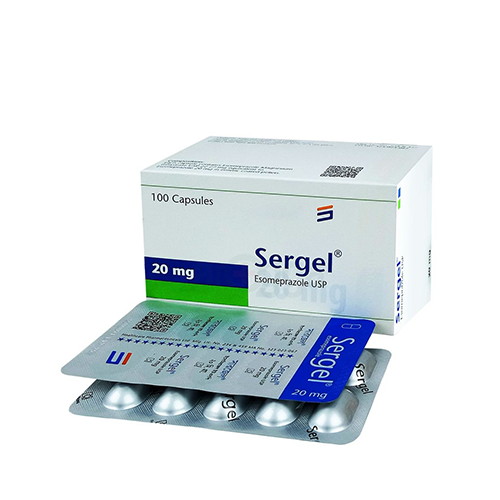
Sergel 20 mg Capsule ~ 1 Strip
Indications of Sergel 20 mg
Sergel 20 mg is indicated: To alleviate GERD-related
symptoms such as persistent heartburn and others. In order to treat erosive
esophagitis. To maintain the erosive esophagitis's ability to recover. for the
eradication of Helicobacter pylori infection in individuals with duodenal ulcer
disease when used in conjunction with amoxicillin and clarithromycin. Syndrome
of Zollinger-Ellison. Duodenal & gastric ulcers caused by acid dyspepsia
Dosage of Sergel 20 mg
Healing of Erosive Esophagitis: 20 mg or 40 mg Once Daily
for 4-8 Weeks. The majority of patients are healed within 4 to 8 weeks. For
patients who don't heal after 4-8 weeks, an additional 4-8 weeks of treatment
may be considered. Maintenance of Healing of ErosiveEsophagitis: 20 mg Once
Daily (Clinical studies did not extend 6 months). Symptomatic GERD: 20 mg Once
Daily for 4 Weeks. If symptoms do not resolve completely after 4 weeks, an
additional 4 weeks of treatment may be considered. Helicobacter Pylori
eradication: Triple Therapy to reduce the risk of Duodenal Ulcer
recurrence-Esomeprazole 40 mg Once Daily for 10 days, Amoxicillin 1000 mg Twice
Daily for 10 days, Clarithromycin 500 mg Twice Daily for 10
days.Zollinger-Ellison Syndrome: The dose is 20-80 mg once daily. The dosage
should be adjusted individually and treatment continued as long as clinically
indicated. Acid-related Dyspepsia: 20-40 mg once daily for 2-4 weeks according
to the response. Duodenal ulcer: 20 mg once daily for 2-4 weeks. Gastric ulcer:
20-40 mg once daily for 4-8 weeks.Injection: The recommended adult dose is 40
mg Sergel 20 mg given once daily by intravenous injection (not less than 3
minutes) or intravenous infusion (10 to 30 minutes). Esomeprazole IV injection
should not be administered concomitantly with any other medications through the
same intravenous site. Treatment with Esomeprazole IV injection should be
discontinued as soon as the patient is able to resume treatment with
Esomeprazole delayed-release capsules. Safety and effectiveness in paediatric
patients have not been established.
Administration of Sergel 20 mg
One hour before a meal, take one Sergel 20 mg pill or
capsule and consumed it whole. Delayed-Release Oral Suspension use guidelines:
The entire packet's contents should be placed in a little glass with 15 ml of
water. After thoroughly stirring the mixer, give it two to three minutes to
thicken. Within 30 minutes, stir once more and consume. Add extra water, swirl,
and drink right away if any medicine is still present after consumption. If the
suspension is to be taken via a nasogastric or gastric tube, 15 ml of water
should be placed in the syringe. After shaking the syringe, wait two to three
minutes for the suspension to thicken. Within 30 minutes, shake the syringe and
administer a gastric or nasogastric injection into the stomach. Use a syringe
that is the right size. Shake and ingest any leftover substances from the
gastric or nasogastric tube. A gradual intravenous injection of esomeprazole IV
is the recommended method of administration. 5 ml of the specified solvent
(WFI) is added to the vial to create the IV injection solution. Upon
reconstitution, the injection should be administered gradually over a minimum
of three minutes. When kept at room temperature up to 30°C, the solution must
be used within 12 hours of reconstitution. Nothing needs to be refrigerated. If
there are any visible particles in the reconstituted solution, do not use them.
Interaction of Sergel 20 mg
CYP2C19 and CYP3A4 substantially metabolize esomeprazole in
the liver. Studies conducted both in vivo and in vitro have demonstrated that
esomeprazole is unlikely to inhibit the CYPs 1A2, 2A6, 2C9, 2D6, 2E1, and 3A4.
There shouldn't be any clinically significant interactions with medications
that these CYP enzymes process. According to studies on drug interactions,
esomeprazole does not interact clinically with phenytoin, warfarin, quinidine,
clarithromycin, or amoxicillin. The main enzyme that metabolizes esomeprazole,
CYP2C19, may be affected by esomeprazole. Diazepam's clearance was reduced by
45% when Esomeprazole 30 mg and diazepam, a CYP2C19 substrate, were taken
together. Diazepam plasma levels have been seen to rise 12 hours after dosage
and beyond. Esomeprazole reduces the production of stomach acid. As a result,
esomeprazole may hinder the absorption of medications whose bioavailability is
significantly influenced by gastrointestinal pH. (e.g., ketoconazole, iron
salts and digoxin). The pharmacokinetic profile of esomeprazole does not appear
to be altered by the co-administration of oral contraceptives, diazepam,
phenytoin, or quinidine. Esomeprazole and 14-hydroxy clarithromycin plasma
levels have increased as a result of co-administration with clarithromycin,
amoxicillin, and other medications.
Contraindications
Those with known hypersensitivity to any of the
formulations should not take esomeprazole.
Side Effects of Sergel 20 mg
The side effects of Sergel 20 mg that are most frequently
mentioned are headache, diarrhea, nausea, flatulence, abdominal pain,
constipation, and dry mouth. When compared to short-term treatment, relevant
side events occurring after maintenance therapy up to 12 months do not differ
in type.
Precautions & Warnings
General: A positive symptom response to Sergel 20 mg does
not rule out the possibility of stomach cancer. Patients should take
esomeprazole capsules at least an hour before meals, according to the
information. One spoonful of applesauce can be put into an empty bowl, the
Sergel 20 mg capsules can be opened, and the pellets inside the capsule can be
carefully dumped onto the applesauce for patients who have trouble swallowing
capsules. After combining the pellets and applesauce, immediately ingest the mixture.
Use only cold applesauce that is soft enough to be taken without chewing. You
shouldn't chew or shatter the pellets. It is not advised to keep the
pellet/applesauce mixture for later usage. While taking esomeprazole, antacids
are acceptable.
Overdose Effects of Sergel 20 mg
Sergel 20 mg has been shown to be deadly in rats at a
single oral dose of 510 mg/kg, or nearly 103 times the human dose on the basis
of body surface area. The main symptoms of acute poisoning are decreased motor
activity, changes in breathing frequency, tremors, ataxia, and sporadic clonic
convulsions. Esomeprazole overdoses are not known to have occurred.
Esomeprazole has no known particular countermeasure. Dialysis isn't expected to
remove esomeprazole because of how widely it is protein bound. If an overdose
occurs, symptomatic and supportive care should be provided. The possibility of
ingesting numerous drugs needs to be taken into account, just like with any
overdose.
Storage Conditions
Keep in a dry area at a temperature that does not go above
30°C. shield from moisture and light. Keep out of children's reach.
Mode Of Action
By specifically inhibiting the H+/K+-ATPase in the gastric
parietal cell, the proton pump inhibitor esomeprazole reduces stomach acid
output. The first single optical isomer of a proton pump inhibitor,
esomeprazole (S-isomer of omeprazole), offers superior acid control over
racemic proton pump inhibitors. Absorption: The enteric-coated pellet version
of esomeprazole magnesium is what is found in esomeprazole capsules. Peak
plasma levels (Cmax) after oral dosing happen about 1.5 hours later (Tmax). The
area under the plasma concentration-time curve (AUC) increases by a factor of
three from 20 to 40 mg, and the Cmax increases correspondingly when the dose is
raised. The systemic bioavailability is about 90% at repeated once-daily dosage
as opposed to 64% following a single dose. When compared to fasting settings,
the AUC following a single dosage of esomeprazole is reduced by 33-53% after
eating. It is recommended to take esomeprazole at least an hour before meals.
Distribution: Plasma proteins are 97% bound to esomeprazole. Across the
concentration range of 2–20 mmol/L, plasma protein binding remains stable. In
healthy volunteers, the apparent volume of distribution at steady state is
roughly 16 L. Esomeprazole is extensively processed by the cytochrome P450 (CYP)
enzyme system in the liver. Esomeprazole's metabolites don't have any
anti-secretory properties. The CYP2C19 isoenzyme, which produces the hydroxy
and desmethyl metabolites, is essential for the majority of the metabolism of
esomeprazole. The CYP3A4 enzyme, which produces the sulphone metabolite,
determines the residual amount. Excretion: Esomeprazole has a plasma
elimination half-life of about 1-1.5 hours. The amount of parent medication
discharged in urine is less than 1%. Esomeprazole is an oral medication that is
excreted in two ways: 80% of an oral dose is found in the urine as inactive
metabolites, and the remaining 20% is found in the feces as inactive
metabolites. Esomeprazole magnesium 40 mg once daily is administered for 7 days
in combination with clarithromycin 500 mg twice daily and amoxicillin 1000 mg
twice daily. Esomeprazole's average steady-state AUC and Cmax increased by 70%
and 18%, respectively.
Pregnancy
There is no sufficient and reliable research on expectant
mothers. No teratogenic effects have been identified in animal investigations.
Esomeprazole's excretion in milk has not been investigated. So, if the usage of
esomeprazole is deemed necessary, breastfeeding should be stopped.
Pediatric Uses
Pediatric Use: Pediatric patients' safety and efficacy have
not been shown. Geriatric Use: There haven't been any overall variations in
safety and effectiveness between elderly and younger people, and other recorded
clinical experience hasn't found differences in reactions between elderly and
younger patients, although it's possible that certain older people may be more
sensitive. Hepatic Insufficiency: For individuals with mild to moderate hepatic
insufficiency, no dosage change is advised. On the other hand, a dose of 20 mg
once daily should not be exceeded in individuals with severe hepatic
impairment. Renal Insufficiency: As less than 1% of esomeprazole is eliminated
unaltered in the urine, it is not anticipated that the pharmacokinetics of
esomeprazole in patients with a renal impairment will differ from those in
healthy volunteers.
Q: What is Sergel 20?
Sergel 20mg is esomeprazole, a proton pump inhibitor (PPI). PPIs work by
reducing the amount of acid produced in the stomach. Sergel 20mg is used
to treat gastroesophageal reflux disease (GERD), ulcers, and other conditions
that involve too much stomach acid.
Q: What is Sergel 20mg used for?
Sergel 20mg has multiple uses. It eases heartburn and relieves GERD symptoms.
It also aids in healing erosive esophagitis, a condition caused by stomach acid
damaging the esophagus lining. Additionally, Sergel 20mg effectively prevents
erosive esophagitis recurrence.
Q: What are the side effects of Sergel 20mg?
Sergel 20mg may cause common side effects like headaches, diarrhea, nausea,
gas, stomach pain, constipation, and dry mouth. There aren't any differences in
the types of side effects between long-term (up to 12 months) and short-term
use.
Q: Can I take Sergel 20 if I am pregnant or breastfeeding?
Sergel 20mg doesn’t have any side-effects if you are pregnant or breastfeeding.
. You still should talk to your doctor about the risks and benefits of taking
Sergel 20.
Q: How long does it take for Sergel 20mg to work?
Sergel 20 usually starts to work within a few hours of taking it.
Frequently Brought Products
Product Queries (0)
Login Or Registerto submit your questions to seller
Other Questions
No none asked to seller yet
-
৳12.00
-
৳12.00

Subscribe to our newsletter for regular updates about Offers, Coupons & more
Follow Us
Mobile Apps